

Get Started
Willow is currently serving patients 18+ years of age located in New York and North Carolina.
For any questions, call: 844-488-3223


Booking Confirmation
Willow is currently serving patients 18+ years of age located in New York state.
Suicidal Ideation Treatment Options: A Compassionate Guide to Getting Help



Thoughts of suicide are a sign that someone needs more support. There is hope. Please know that there are many effective suicidal ideation treatment options available. If you are experiencing thoughts of suicide, or if you are supporting someone else who is, we created this article as a resource to orient you to the available care options.
If you or a loved one is experiencing thoughts of suicide, please call or text the 988 Suicide & Crisis Lifeline at 9-8-8. Trained crisis counselors are available 24 hours a day, 7 days a week to support people in emotional distress and those at risk of suicide.
Understanding Suicidal Ideation
Suicide risk exists on a spectrum. Suicidal ideations are thoughts about death or suicide that can range widely in type and intensity. Suicidal ideation includes thoughts about suicide as a way to escape intense emotional pain and any thoughts related to how one might carry out a plan. These differ from developing the intent to carry out that plan or making a suicide attempt, as these types of thoughts and actions are known as suicidal behaviors.
Experiencing thoughts about suicide is a common symptom of many mental health concerns. Over 12 million Americans experience suicidal ideation each year, while 49,000 lives are lost to suicide. This is a serious public health issue that affects all communities and people from all walks of life. Many lives are saved by asking for help and support.
When to Seek Immediate Help
Since suicide risk is a spectrum, it is crucial to understand when someone is at high risk and needs immediate help. Some signs that someone is at high risk include:
- Statements like "you'll be better off without me"
- Talking about suicide
- Making specific plans
- Having access to lethal means
- Making final arrangements or telling people goodbye
- Reckless or dangerous behaviors
- Having the intention to go through with a plan for suicide
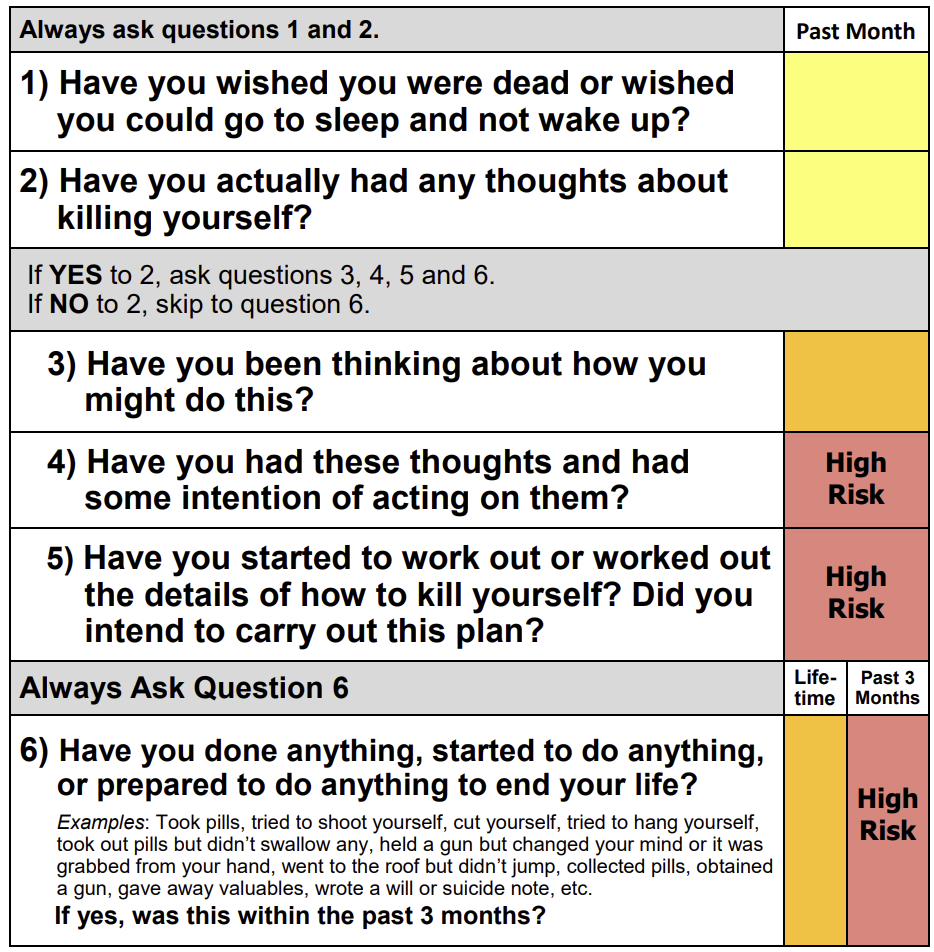
We recommend using the Columbia-Suicide Severity Rating Scale (C-SSRS), a simple tool that is the most evidence-based intervention to help assess for suicide risk and determine what course of action is recommended. This tool guides people through the signs from least to most severe.
If the person answers “Yes” to question 2 or 3, they should be assessed by a mental healthcare clinician. If YES to 2 or 3, seek behavioral healthcare for further evaluation. If the answer to 4, 5, or 6 is YES, get immediate help: Call 988 or 911, or go to the emergency room. STAY WITH THEM until they can be evaluated.
Treatment Options for Suicidal Ideation
Suicidal ideation is highly treatable, and many people go on to recovery and lead healthy, satisfying lives after experiencing suicide risk.
Crisis stabilization and same-day support
Crisis programs, like those offered by Willow Health, can be an easily accessible entry point to care for people who need urgent support right now. Many offer same-day support. Crisis programs can include individual therapy, medication management services, peer recovery support and skills-building, care management services, and can prioritize safety planning and stabilization.
Intensive outpatient programs (IOP)
Intensive outpatient programs meet for 3-4 hours a day, 3-5 days a week, and they offer group therapy or education, and may also include one-on-one appointments afterward. Some IOPs, like Willow Health, include individual therapy, medication management services, peer support coaching, and care management.
Partial hospitalization programs (PHP)
Partial hospitalization programs offer programming similar to IOPs; however, they tend to include a medical monitoring component or serve people who require a high level of support.
Inpatient psychiatric care
Inpatient care includes 24/7 safety and medical monitoring in a hospital or residential setting and is for people at high risk for safety or medical concerns.
Outpatient care: therapy and medication support
Routine outpatient services include therapy, which can be individual, couples, family, or group. Medication management services are often offered monthly or quarterly once someone has found a regimen that works for them.
DBT, CBT, and other evidence-based approaches
There are many evidence-based treatment modalities that address and reduce suicidal ideation. These include:
- Cognitive Behavior for Suicide Prevention: The focus is on the thoughts, feelings, behaviors, and core beliefs that contribute to increased risk of suicide. By acquiring new skills and tools, people are better equipped to manage and resolve stressors and make positive changes in their lives.
- Dialectical Behavior Therapy: This modality uses four main pillars of focus, mindfulness, emotional regulation, interpersonal effectiveness, and distress tolerance to help people learn new ways of coping, manage their emotions, and improve relationships, which helps to reduce one’s risk of suicide.
- Collaborative Assessment and Management of Suicidality (CAMS): A structured therapeutic tool that focuses on the “drivers” of suicide risk, or the things in someone’s life that are contributing to their thoughts of suicide, hopelessness, and emotional pain.
What to Expect When You Reach Out for Help
There are many misconceptions about what will happen if someone reaches out for support, and many people delay seeking help because they're afraid of hospitalization, losing autonomy, or not being believed. We want to explain what people should expect if they reach out for help.
What happens when you contact a crisis line or virtual provider
You will speak to a trained, calm professional who cares about your health and well-being. They will ask that you share your concerns and what prompted you to make the call. They will work with you to identify next steps to ensure your safety while taking your needs and preferences into account.
What a clinical assessment for suicidal ideation involves
Assessing for suicide risk includes determining how significant the risk factors you are experiencing are, weighed against any resources or supports you may also have, also called protective factors.
The discussion will include allowing the person to have a voice in their treatment decisions and to explain why they agree or disagree with any recommendations. Hospitalization isn’t always the outcome if someone is found to be at a low risk and has a safe environment. Inpatient care may be recommended if someone is an active danger to themselves, and is a temporary form of support to ensure someone’s level of risk is reduced before they reenter their community.
How Willow Health Supports People Experiencing Suicidal Ideation
Willow Health was created with the needs of people experiencing a mental health crisis at the forefront. We know how frustrating it can be to try to get the help you need when you need it.
That’s why we offer same-day virtual access to trained crisis clinicians who can guide you through your options and develop a care plan. Safety planning is a highly effective way to ensure people remain safe during outpatient care, and it is a core component of the care we provide.
For many of our patients, Willow Health is a bridge of safety and support that helps them access other treatment programs and long-term sources of support. Our services are for people who need more than a therapy appointment but haven't reached the point of requiring hospitalization. Our goal is to meet people where they are and partner with them to ensure their short-term safety and their long-term success.
Frequently Asked Questions About Suicidal Ideation Treatment
Many people have questions about seeking treatment if they are experiencing suicidal ideation. Please give us a call at 646-814-1530 if we didn’t answer all your questions here, and to learn more about our crisis program and intensive outpatient program (IOP).
Will I be hospitalized if I tell someone I'm having suicidal thoughts?
More people than not experience suicidal ideation and don’t require inpatient hospitalization. It is true that some people do need a secure treatment program to ensure their safety, and that for many people, this is a crucial step towards recovery.
Can suicidal ideation be treated virtually?
Many people who are dealing with suicidal ideation can be treated in an outpatient setting and access care virtually. It’s not for everyone in all circumstances; however, many people wouldn’t be able to access high-quality, timely treatment without virtual options like those offered by Willow Health.
What is the most effective treatment for suicidal ideation?
Cognitive behavioral therapy and dialectical behavioral therapy have been shown by research to be the most effective in the treatment and management of suicide attempts and suicidal ideation.
How do I support someone I love who is experiencing suicidal ideation?
One of the most effective ways you can support them is by asking them directly if they are thinking about suicide, which does not “put an idea in their head.” Use the C-SSRS outlined above and follow the recommendations to keep them safe. Don’t just show up in times of crisis; people need meaningful, ongoing support. Also, remember to take care of yourself by setting boundaries and delegating as needed to support your mental and physical well-being.
Sources
Suicide - National Institute of Mental Health (NIMH)
U.S. National Trends and Disparities in Suicidal Ideation, Suicide Attempts, and Health Care Use
The Columbia Lighthouse Project
Frequently Asked Questions About Suicide - National Institute of Mental Health (NIMH)
This article is provided for educational purposes only and is not to be considered medical advice or mental health treatment. The information contained herein is not a substitute for seeking professional medical advice for health concerns. Use of the techniques and practices outlined in this article is to be done cautiously and at one’s own risk, and the author/publisher is not liable for any outcomes a reader may experience. The author/publisher is not liable for any information contained within linked external websites. If you are experiencing a life-threatening emergency, please call 911 or the Suicide and Crisis Lifeline at 988.